The set, like the characters on Industry, is sleek and expensive, yet feels empty.
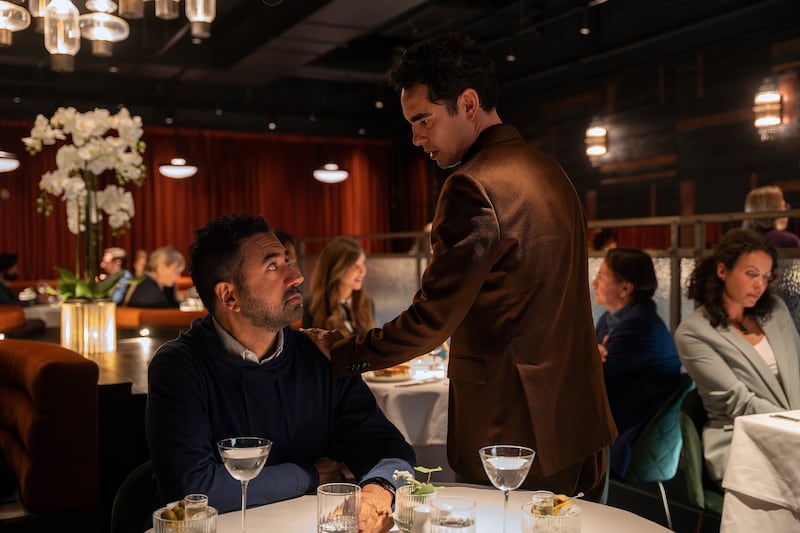
An expanse of Bad Wolf Studios in Cardiff, Wales, serves as offices for Tender, a new venture on Industry, returning for its fourth season on HBO Sunday, Jan. 11. Max Minghella (The Handmaid’s Tale) joins the cast as Whitney, the mastermind behind the burgeoning fintech company. Sir Henry Muck (Kit Harington, Game of Thrones) is brought on as CEO.
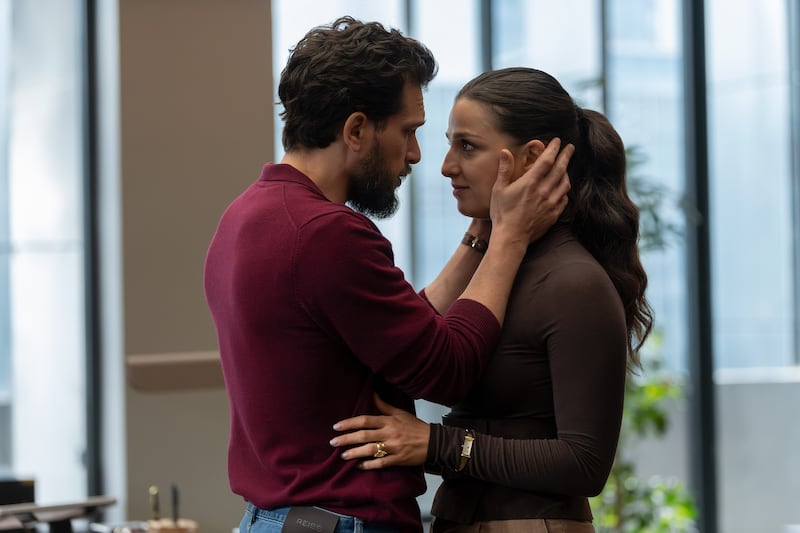
This set, a marvel of mid-century design and massive glass walls, is punctuated with neon signs: “The stars are real,” “Your future is a mountain.” The sort of aphorisms meant to be thought-provoking, but here, in harsh lights, can be interpreted as threats. No matter how lush the settings and polished the manners, threats always lurk on Industry.
The drama began as a look at the most junior traders at Pierpoint, a fictional, prestigious investment bank where recent graduates work relentlessly—sometimes to death. They rake in millions for the company, party hard, and return after a few hours’ sleep to repeat the process.

Now, these once-naïve Gen Z’ers are more experienced, and this season finds the stars, Harper (Myha’la, Modern Love) and Yasmin (Marisa Abela, Barbie), at new points in their lives and adding dimensions to ruthlessness.
“Season 4 is all about a big financial fraud, and how it plays out,” co-creator Mickey Down says. “There’s a lot more politics and finance stuff. We wanted it to be about more politics and finance. We wanted it to be about power and capitalism.”
The “we” is his partner, Konrad Kay.They co-created, directed, wrote, and executive-produced the sleeper hit, which bowed during the pandemic. By last season, Industry earned the prime spot on HBO.
“We were so green when we started out,” Kay recalls, saying their initial goal was “just to get the show on the road and see if the ship wouldn’t sink. That doesn’t sound very ambitious, but the real estate of 9 pm on Sunday on HBO is something that me and Mickey grew up as being the hallowed, sacrosanct part of television.”
Down and Kay may share a brain by now; they listen to each other but also finish each other’s sentences. The duo met at Oxford and were briefly bankers. They understand the genteel, often mysterious (at least to Americans) mores of the British upper class, and the finance bros capable of garrotting their grandmothers if it boosts profits.
“People want to make money young, like it’s about really carving out identity based on money, and that’s success and power,” Down says. “That has analogs to different industries, but really, where the industry is money that becomes the North Star.”
The collaborators sit in director’s chairs, overseeing the seventh episode, talking softly while actors run through a scene. Ultimately, they did 54 takes.
This action unfolds on another set, a very convincing newsroom for The Patriot. Computer screens flash mock-ups of pages, and bookcases hold files of letters to the editor. Henry’s uncle, Viscount Alexander Norton (Andrew Havill, The Crown), The Patriot’s publisher, wants to do what he can to help his nephew. And Henry needs all the help he can get. Luckily, his wife, Yasmin, will deploy whatever shadiness she can devise to take down anyone who threatens them.
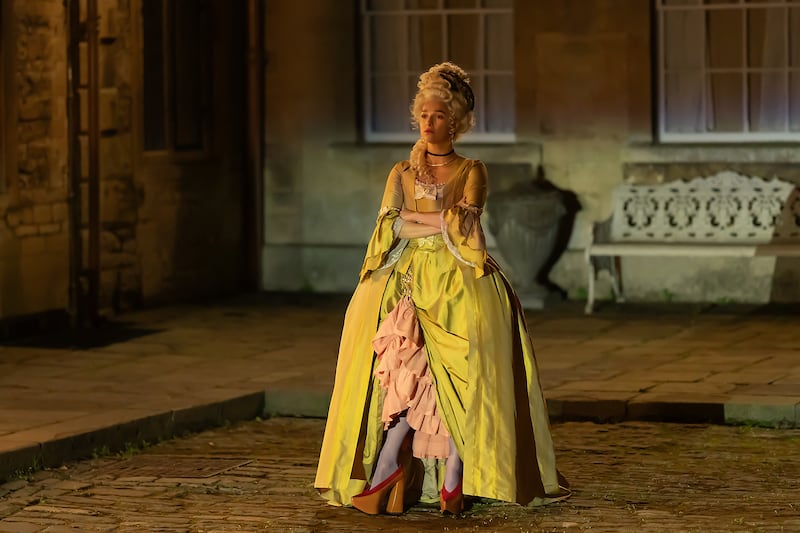
Some folks, to their eventual detriment, tend not to take Yasmin seriously. This beautiful, polished daughter of privilege seems a little too eager to please. She’s vulnerable yet confident, worldly yet sheltered. Above all, Yasmin is calculating, as is her main foil, Harper. Yasmin desperately needs to be, as she says, necessary. She is often put in situations that require more knowledge than she possesses. However, her connections and willingness to use them are unsurpassed.
Most of the characters on this are children of privilege. In Yasmin’s case, her father, an exorbitantly wealthy lowlife, damaged her. Born rich, not titled, Yasmin wants more. Resilient and determined, failing to get her way isn’t even a notion.
All of the characters carry the stench of entitlement, but not all are wealthy graduates of elite schools. In fact, Harper, brilliant and reckless, did not graduate and has been lying from the start. She’s an American with no handle on what to wear, how to act, or move in these circles. Harper, though, is a quick study, with the intellect, confidence, and bravado of a powerbroker.
Industry celebrates wealth yet lays bare how it feeds the internal demons gnawing at the characters. But let’s be real. Being miserable on daddy’s yacht beats being miserable on the downtown 6 subway. In the age of craven greed, though, it’s surprising that any show about accumulating such wealth intrigues. Hadn’t we had enough with Billions? Succession? Trump?

And yet, Industry continues to compel. It’s been almost 16 months since the last episode of Season 3. An indication of a great series is that, during its hiatus, you find yourself wondering about the characters.
What will Harper do? What does she still need to prove? Can Yasmin make peace with leaving Robert (Harry Lawtey, Mr. Burton), whom she loved, but was not the aristocrat her husband Henry is? Henry’s addictions and sexual peccadillos run wild this season.
Tender’s offices, meant to be in London’s Canary Wharf, sound authentic as seagulls screech circling Cardiff Bay. What feels most authentic, however, is Tender’s coldness. Naturally, every business aims to make money, but at this level, it’s more; it’s a black hole of avarice.
Harington’s scenes with Minghella are taut, surprising, and rivaled only by the scenes between Myha’la and Abela. It’s not just that journalists agree to embargoes to visit a set—spoiling anything from this season would be criminal. However, it’s fair to say the characters are who they were, only more so, while Whitney brings surprises.

“He was enigmatic to me when we were shooting it,” Minghella says of his character. “I keep using the word fun, but it was, it was fun to kind of peel the layers.”
No one who smiles easily would describe Whitney as fun, but Minghella is referring to the process. After watching some episodes, he says, “I found it even more opaque, actually. Mickey and Konrad made some really interesting, cool changes in post that actually quite dramatically shift the character, and, in some ways, brought it a little bit closer to me. That was different than what I thought I was playing.”
As layered as Industry is, its heart remains the interactions between the two women. In a joint interview, Abela and Myha’la each considers her character’s evolution.
“The most obvious evolution is financially,” Myha’la says. “Harper is doing the best that we’ve known her to do. She moves to London in Season 1 as an internet analyst. And by the beginning of Season 4, we meet her as a fund manager. She’s obviously struggling a little bit. She feels like she doesn’t have the autonomy that she’s promised, but she’s running her own book and making her own decisions in terms of where people’s money is allocated and what pockets of the market she’s moving around. So, this is the highest you’ve seen her.”

“We met Yasmin when she was 22, and she was incredibly nervous,” Abela says. “She knew probably deep down what her skills and her weaknesses were, but was too afraid to lean super far into her skill set because, I think, that she was ashamed of not being good at what it was that she thought she should be good at, whereas now I think that Yasmin is very much a self-assured person.”
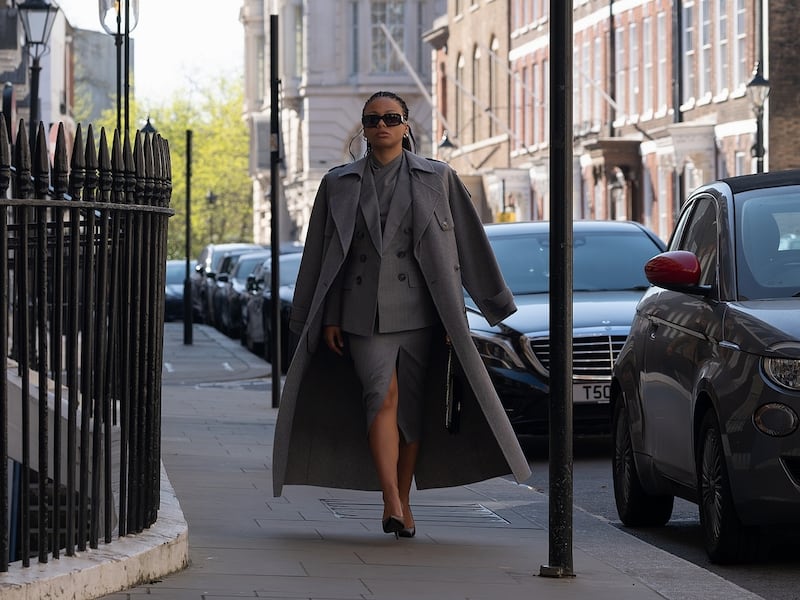
She should be. Yasmin was reared to move in rarified circles. She swans about in fabulous outfits, and costume designer Laura Smith cites Carolyn Bessette Kennedy as an inspiration for the character’s style. Harper now looks like the boss she is in a spectacular, bespoke wardrobe.
“This season, even though she’s got a handbag, and it’s a Chanel on a long chain, it’s still very small,” Smith notes about Harper. “You couldn’t put a laptop in it. It tells you a very different story because now she has people to carry it for her.”
Smith’s scholarly approach is apparent in the details. Eric (Ken Leung, Lost), who continues to school Harper, sports dagger-shaped cufflinks.
“I was thinking about Medici bankers who would then literally pierce armor with stiletto blades, and you’d bleed out, and you wouldn’t even know that you were bleeding,” Smith says.
The leads’ looks remain flawless, but it would be an oversight to ignore Henry’s disheveled appearance, as done by hair and makeup supervisor Mirna Curak.
“Henry’s not in a very good place when we start this season, and with everything happening around him, like he doesn’t sleep, he doesn’t look after himself, so we really wanted to try to show that with hair and makeup,” Curak says.
“He is a tragic character,” Harington acknowledges. “The challenge this year was to understand why he’s a tragic character. Last season, he was more peripheral, and he was quite villainous in not an obvious way, hopefully, but he swooped in and stole a girl. Yeah, he was a posh-boy prick. This year was very much an in-depth look at who he really was as a fully rounded person.
“I got the privilege of doing that in-depth in one episode early on, so that we could understand him as the season went on, and why he was in such a place as he was,” Harington continues. “For anyone to have gone through the trauma that he went through at such a young age—there’s no one on Earth that should go through that, no matter how morally dubious, no matter how narcissistic. Hopefully, the question it poses is: Why do people end up the way they are? Why do they fall into addictive cycling?”
This season proves why Industry caught on, even if your natural inclination is to eat the rich. The season’s final scene will stir sympathy for someone who appears to have it all.
Minghella, who brings a dead-eyed stare to Harington’s lost gaze, notes this is the rare series that a viewer could start watching with these eight episodes and not be lost.
True, though, why deny yourself past seasons?
“It’s been a journey,” Down says. “It’s a privilege that it’s come back because it’s come back every time when we thought it’d be canceled. And every season feels totally different from the last.”