(Warning: Spoilers ahead.)
Palm Royale has a way of pulling you into its wonderful, wacky orbit. Being on the periphery comes with its own set of challenges, as FBI Agent Virginia Lyons (Amber Chardae Robinson) and Shiny Sheet society reporter Ann Holiday (Mindy Cohn) know all too well. The two women bond over their shared experiences as outsiders and their desire to locate the real person responsible for the attempt on President Nixon’s life.
The second season of the Apple TV period melodramedy is racking up its mysteries, giving both Virginia and Ann plenty to investigate to bolster their respective careers. The compelling duo brings vital skills to the table and insightful commentary about this affluent community.
In the hunt for shooter Mary Davidsoul (Julia Duffy), Ann’s encyclopedic knowledge puts the pair on a collision course with Maxine Dellacorte’s (Kristen Wiig) audacious plan to free Linda Shaw (Laura Dern) from a death row fate.
During Virginia’s undercover operation as a feminist bookstore owner, she grew close to Linda, and despite her recently revealed professional duty, Virginia does not turn against her friend. Ann promises this daring escape will be off the record. Thankfully, it is all on the record when The Daily Beast’s Obsessed sat down with Robinson and Cohn to discuss doing a physical sequence in period attire, their partnership, and the reality of this glitzy world.
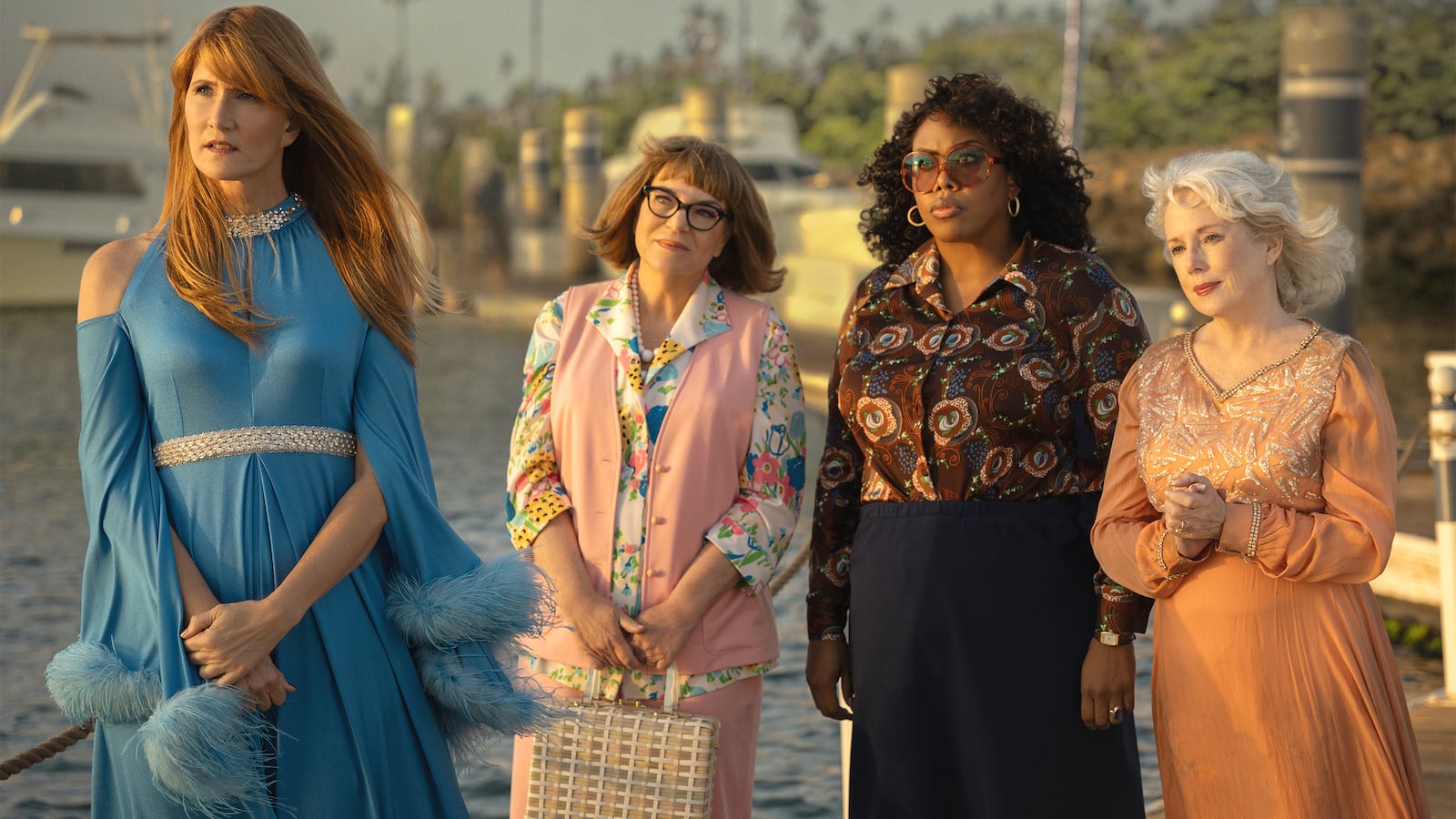
The plan is to meet Douglas (Josh Lucas) and his seaplane so he can fly Linda to safety. What follows is Palm Royale firing on all comedy cylinders with Wiig, Dern, Duffy, Cohn, and Robinson emulating a famous Pamela Anderson-starring series. Instead of red swimsuits, they sport an array of Marabou feathers, impractical frocks, and patterned workwear.

“Shooting those big scenes like that, it’s always fun. We get a chance to bond with each other, because we’re not on set together all the time,” Robinson says. “When we were doing the Baywatch scene, it was 6 am in Long Beach on the beach, and this was my first time running in the sand. We were running in pantyhose. We had a blast.”
Given the often outlandish set-ups, Robinson has to remember she’s at work. Especially because Wiig unintentionally makes Robinson break. “She is hilarious, but she has so much depth. She takes it 100 percent serious,’ says Robinson. “You’re laughing as an audience member, and I forget that I’m in a scene. Sometimes, I have to turn away or bite my tongue because the cameras are rolling, and I’m like, ‘This girl is hilarious.”
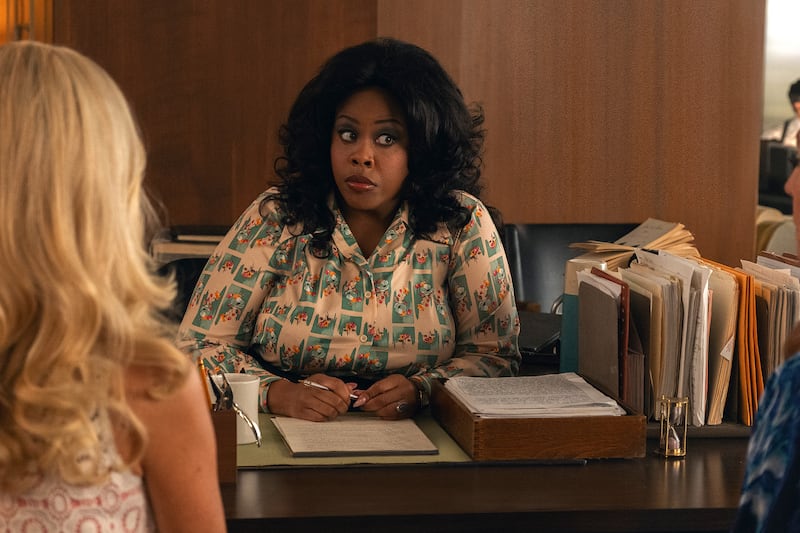
The cast is a murderer’s row of acting titans. Chatty Gen X icon Cohn briefly struggles (and then poking fun at herself in the third person) to describe the experience of this action sequence and other such group scenes: “It really is an actor’s dream to be able to play with people at this level. I don’t have the words. Obviously, she’s speechless— that’s a first. It’s otherworldly.”
It isn’t until the end of the day, when Cohn is on her way home, that it hits her. “I literally have a proper weep over just because I almost have to pinch myself that that day just happened,” Cohn says. “I am a little bit of a disassociator—TMI—so afterwards, when I’m back in my body, I tend to get quite emotional about what this has given to us, as actors, with each other.”

Before they discover Linda, Maxine, and Mary in the prohibition tunnels, the two women have a revelatory conversation about their roles in a wealthy enclave with discriminatory membership practices. First, Virginia observes that Ann is an expert on this group of women. “Oh, I know everything about them, but I’m only invited to the parties to write about them. I’d never be able to join the club,” says Ann. Rather than let the implication hang in the air, Virginia deduces aloud that Ann is Jewish.
Originally, the scene was written in a different way. Creator Abe Sylvia floated this new version, and the pair leaped at the changes. “What a wonderful way to talk about it, right? Instead of it just being out there. It was a delicious little secret that then turns into this growth spurt for the two women,” says Cohn. “We are the ‘other’ in this community, and yet we’re in it.”
Cohn mentions how the writing in this scene digs into the push-pull of being Ann and Virginia in this setting. “It is also one more tip of the hat to Abe Sylvia, who can do this with such class and dignity,” says Cohn. “And in such a way that it’s not [like] ham and cheese on a plate. It’s divine.” As someone who talks with my hands, I got such a kick out of Cohn miming the ham and cheese part to emphasize this isn’t simplistic storytelling.
After sharing this piece of herself, Ann asks about Virginia’s path to the FBI. Virginia thought that if she could get on the inside, then she could protect her community. But then both Dr. Martin Luther King Jr. and Fred Hampton were killed. “I thought f--- it, you want me to keep an eye on subversives? I’m gonna take out the real villains,” Virginia says. It also speaks to why Virginia actively helps rather than arrest Linda.
“I think it’s important to show both sides of this world, because they do exist. I think the high society world is fun and it’s cute and exciting, and there’s this level of escapism,” says Robinson. “But I think the world that Virginia lives in is very real. It’s very grounded.” Not that Virginia doesn’t get to play in the hijinks sandbox, including running on the beach, and whatever else is down the line. (“There’s more to come, my darling,” says Cohn when I mention big group scenes.)

“It’s important to show the layers within her, but also the layers within the high society, because it’s not just glitz and glamor,” says Robinson. “There’s a lot underneath the surface. I think that’s why people love this show so much, because it makes it so rich. It’s not just camp. There’s more to it; there’s death.”
The growing body count impacts how Ann approaches her job. Cohn likened Ann to the “Hedda Hopper of Palm Beach” in Season 1. Now Ann has a front row seat to the darker antics, which is as fulfilling to Cohn as it is to Ann: “It’s more of an investigative reporter than just observing. That has been so fun and so delicious to do. I think more relatable to the journalism and stories that I watch as a viewer on TV—or I used to read in the papers—where someone takes months to try and dig something up.”

Even in the Florida off-season, there is plenty to keep Ann and Virginia busy, especially as Norma (Carol Burnett) is stepping up her game. Both Robinson and Cohn relish playing opposite Burnett in a devious role, and their characters are about to get dragged further into this web.
“I think as much as she’d like to, the people around her will not allow her to sit out,” Robinson says. “They won’t let her rest, especially Maxine. Now that Ann’s on board, it’s hard to say no because she has a soft spot in her heart for these people.” It is hard to get access to this world, and even harder to shake free.