
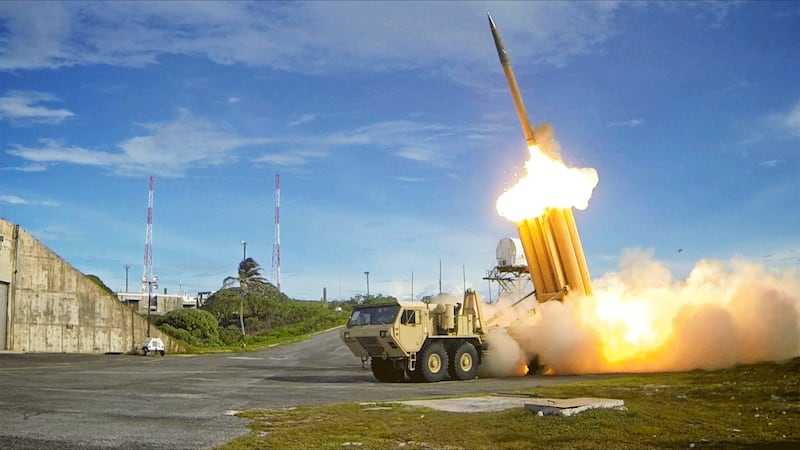
Damning new data from inside the Pentagon suggests that U.S. forces are currently expending more resources defending Israel from missile strikes than Israeli forces themselves.
Three officials with knowledge of Defense Department assessments told The Washington Post on Thursday that the lopsided effort “underscores the extent to which Washington has shouldered the burden of countering Iranian ballistic missile strikes during Operation Epic Fury.”
U.S. forces, according to those assessments, have used up to half their total inventory of certain high-altitude interceptor systems, while Israel has deployed its own at a slower rate.
“The numbers are striking,” Kelly Grieco, a senior fellow at D.C. think tank the Stimson Center, told the Post.
“The United States absorbed most of the missile defense mission while Israel conserved its own magazines,” she went on, adding that the rate of use had left production unable to “keep pace with demand.”
The situation has apparently sparked alarm among American allies in Asia, particularly South Korea and Japan, which depend on U.S. anti-missile defense systems to deter attacks from hostile states such as China and North Korea.
Justin Logan, who directs defense and foreign policy studies at the Cato Institute, a libertarian D.C. think tank, also argues the imbalance suggests a betrayal of Trump’s oft-touted “America First” agenda.
He noted that the Pentagon is thought to have assessed last year that it has as little as 25 percent of the key air defense systems that would be needed to meet the demands of current U.S. defense plans. “Why this wasn’t a screeching siren to Trump officials is a mystery,” he told the Post.
Trump’s war has, for the past few weeks, been in an uneasy limbo. A shaky ceasefire is still in place, and his administration has effectively declared the active phase of the conflict over.

But Trump himself has recently muddied the waters, warning in a Truth Social post earlier this week that the bombing would resume, and at a greater intensity, if Tehran does not meet his terms for a lasting peace.
The Daily Beast has reached out to the White House and Department of Defense for comment. Pentagon spokesperson Sean Parnell poured cold water on the notion of a lopsided defense effort in comments to the Post.
“Ballistic missile interceptors are just one tool in a vast network of systems and capabilities that comprise a layered and integrated air defense network,” he said. “Both Israel and the United States carried the defensive burden equitably during Operation Epic Fury, which saw both countries employ fighter aircraft, counter-UAS systems, and various other advanced air and missile defense capabilities with maximal effectiveness.”